01 Context
This started personally. My wife is a licensed clinical psychologist; I work in payments and build with AI. Over and over we saw the same person from two different professional angles: the high earner who has "made it" and is quietly running on empty. The clinical world calls them one thing; the faith world calls them another. Neither world reaches them early, because reaching out means first accepting a label — "patient" or "believer" — that they haven't accepted yet.
The market around this person is crowded but missed: faith-aligned therapy marketplaces (still therapy), meditation and devotional apps (no clinical depth), AI therapy chatbots (no spiritual dimension), and faith chatbots (no clinical framework). Six layers of competitors, and a clean gap down the middle: nobody was building an AI that meets you where you are, runs a genuinely clinical discovery process, and only then — with consent — points at a deeper foundation.
02 Problem
High-functioning professionals who are successful on paper but empty underneath have no low-stakes front door to clarity. Therapy asks them to self-identify as needing help; religion asks them to self-identify as believers. Most won't do either yet — so they self-medicate with the next win, the next drink, the next status marker, and the underlying pattern never gets named.
03 Approach & Process
The project advanced through a deliberate research sequence — each milestone made the next decision sharper:
- Human-centered framing & landscape mapping. Defined the persona by a condition (successful-but-empty), not a faith posture, and mapped six competitor layers to locate the gap.
- Clinical framework extraction. Translated my co-founder's 20 years of clinical practice into a structured knowledge base: an intake method, a belief-system map (six profiles), a faith-integration bridge, and five client archetypes.
- Task analysis & workflow modeling (BPMN/UML). Diagrammed the full user journey across roles — user, AI, content engine, and a clinical team — including the parallel safety check and three distinct end states (clarity, clinical handoff, human coaching).
- Assumption mapping. Wrote seven testable assumption cards (three "happy path," four drop-off) so I was testing the riskiest beliefs, not the comfortable ones.
- Build → test → iterate. Shipped a working prototype, then validated it with synthetic personas and human testers before widening access.
04 AI Integration
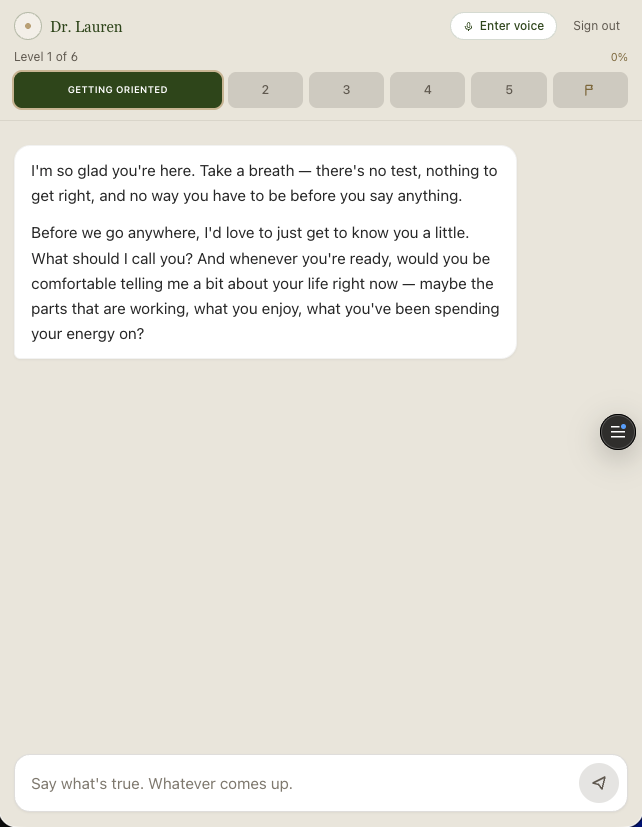
The product is the AI. "Dr. Lauren" is a Claude-powered agent whose system prompt encodes the full clinical framework: a Stage-0 rapport pass, a four-layer "lead domino" sequence that gently moves from safe surface topics toward identity-level beliefs, a confidence-tracked classification of the four false positives, and a consent-gated moment where a spiritual foundation can enter — never as doctrine up front. Around that brain sit voice input/output, authentication, and persistence.
The architecture follows a clean agent loop: sensors (user input) → policy layer (the clinical framework) → tools (the relational mirror, scripture, classification) → quality gates (safety screening, confidence thresholds) → learning signals (engagement, progression).
05 Iteration
The solution-thinking changed more than the solution. Three pivots mattered most:
- Voice: from second brain to interface. I chased real-time voice for its speed and it quietly spawned a second agent that drifted from the clinical brain. I tore it out and rebuilt voice as pure input/output around the original Claude agent. Principle earned: the brain is the product; everything else is swappable.
- Positioning: from "faith-curious" to a condition. Early framing defined the user by a spiritual posture, which narrowed the market and tripped a "religious allergy." I redefined the persona by the condition (successful-but-empty) and made faith the destination, not the front door.
- Telemetry: from confident demo to reliable system. The agent held beautiful conversations but would drop its internal tracking on the longest, most emotional turns — so a great conversation could fail to deliver a result. The fix was architectural (merge state additively across turns), not a prompt rewrite.
| Decision | Options weighed | Call & rationale |
|---|---|---|
| Agent brain | Claude vs. a real-time voice model as the reasoner | Claude owns reasoning. Conversation quality and a stable system prompt mattered more than latency. |
| Voice provider | OpenAI TTS vs. Cartesia vs. ElevenLabs | Cartesia for natural voice and a clean path to cloning; isolated behind one endpoint so it's swappable. |
| Memory model | Full transcript every turn vs. merged structured state | Merged state. Cheaper context and a reliable record of what the agent had learned. |
06 Evaluation
I validated the prototype on three fronts before widening access:
- Synthetic personas. Four custom-prompted agents simulating the core archetypes (plus a crisis-control persona) ran through the live system. All four patterns classified correctly; the crisis persona was caught and routed to human resources every time.
- Human testers + SME review. Six early users plus my clinical-psychologist co-founder reviewed conversation quality, classification fit, and tone.
- Adversarial / edge-case testing. I deliberately probed the safety red-line (hopelessness, self-harm signals) to confirm the system over-refers rather than under-refers.
Risks I identified and addressed:
| Risk | Mitigation |
|---|---|
| False negative on a crisis signal (the critical failure mode) | Deterministic, sticky-and-escalating safety state; the moment a signal fires, the session cannot route to a "result" and surfaces human crisis resources. Bar: 0% false negatives. |
| Category confusion / "bait-and-switch" | Honest about the category up front, consent-led on the spiritual reveal; clinical rigor preserved so it never collapses into "another faith app." |
| Scope-of-practice / liability | Positioned as guided reflection and literacy, not therapy; clinical handoff is a first-class end state, not an afterthought. |
| Automation bias (trusting the model's reveal blindly) | Human-in-the-loop SME review of content; a deterministic server-side reveal gate independent of the model's own claim. |
07 Aspirational Impact & KPIs
As a pre-launch prototype, impact is framed as the KPIs I'd own at scale, tied directly to the friction point:
Supporting metrics I instrumented for: turns-to-reveal, time-to-reveal, drop-off stage, % reaching the pattern reveal, % of returning users, and a qualitative "this resonates" rate from exit reflections.
08 Key Learnings & Stewardship
- The demo lies; the reliability layer tells the truth. A convincing conversation is not a working product. The real product was the state, memory, and safety plumbing around the model — and I under-weighted it because the conversation already felt finished.
- Protect the brain; make everything else swappable. Every failure pushed the same direction: don't compromise the core reasoning for a flashy capability — absorb the chaos at the edges instead.
- Make the AI's work legible. The system was discerning patterns before users could feel it happening. A visible, invitational journey turned hidden intelligence into perceived value — a design discipline separate from making the model smart.
- Honesty is a strategy, not just an ethic. In a trust-dependent category, being transparent about what the product is while staying consent-led on when the sensitive part enters is the whole moat.